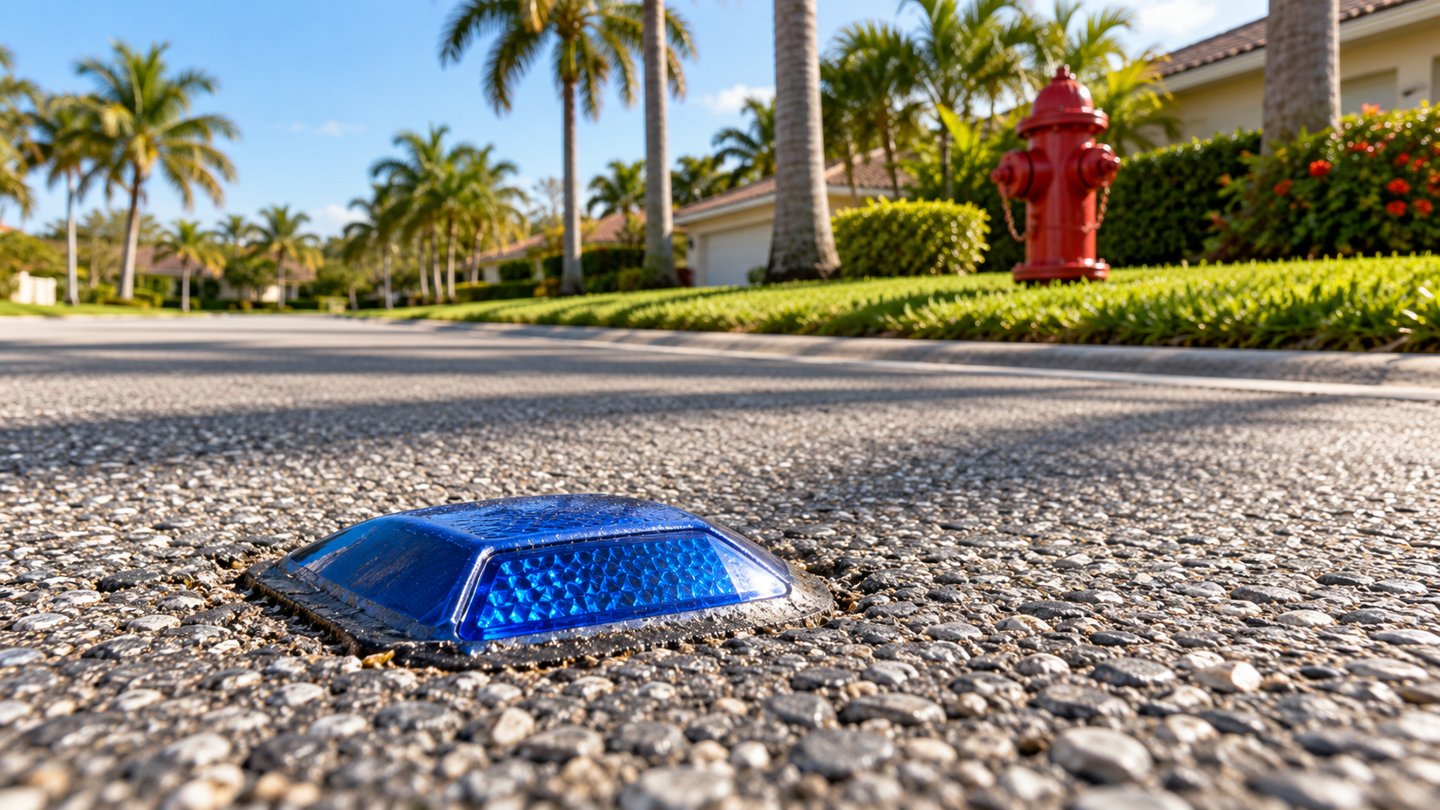
A small blue reflector in the roadway can be a location aid for a nearby fire hydrant. It helps firefighters spot the water source from the road, including when darkness, landscaping, or parked vehicles make the hydrant harder to see.
Florida’s current Traffic Engineering Manual specifically identifies blue raised pavement markers for locating hydrants. The marker is a practical clue for responders, not a decoration or a request for drivers to change lanes.
Why the marker is useful
Picture a crew arriving on an unfamiliar street after dark. A hydrant might be easy to see while walking the sidewalk at noon but less obvious from an approaching emergency vehicle. A reflective marker gives responders another visual reference.
FDOT’s earlier explanatory guidance describes that purpose directly. Its 2026 manual continues to identify the hydrant-marker application and directs professionals to Standard Plans Index 706-001 for placement details.
Placement is not a homeowner project. The correct arrangement depends on the road and the applicable standard. Do not move a marker because it looks off-center or install one yourself using a nearby street as a guide.
What the blue marker does not tell you
- It does not certify that a particular hydrant is working today.
- It does not tell a resident the available water pressure or firefighting flow.
- It does not replace a fire agency’s maps, inspections, or operating procedures.
- It does not turn the road surface around it into a special parking permission area.
Hydrant paint colors and roadway markers serve different purposes. Avoid using a photograph of one to make claims about the other. If you need to know who maintains a hydrant or whether it has an issue, ask the responsible utility or fire agency.
How residents can help
Keep the hydrant visible rather than surrounding it with new shrubs, decorations, stored materials, or storm debris. Before changing landscaping near one, check the local clearance requirements instead of relying on a rule copied from another city.
If you notice a missing marker, a damaged hydrant, or vegetation obscuring it, report the precise location through the appropriate local service channel. A nearby address, intersection, and photograph taken from a safe place are more helpful than “the blue reflector near the entrance.”
Do not enter traffic to take the picture, test a hydrant, paint it, or attempt a repair. A road maintained by the county may have a different contact from a state road or a privately maintained community street.
A small detail with a practical purpose
The next time you notice a blue reflector, think of it as part of the information firefighters use to orient themselves quickly. The best contribution a resident can make is straightforward: keep access clear, report problems accurately, and leave placement and maintenance to the responsible professionals.
Primary sources: FDOT 2026 Traffic Engineering Manual, section 4.3.4; FDOT’s explanation of blue hydrant markers.