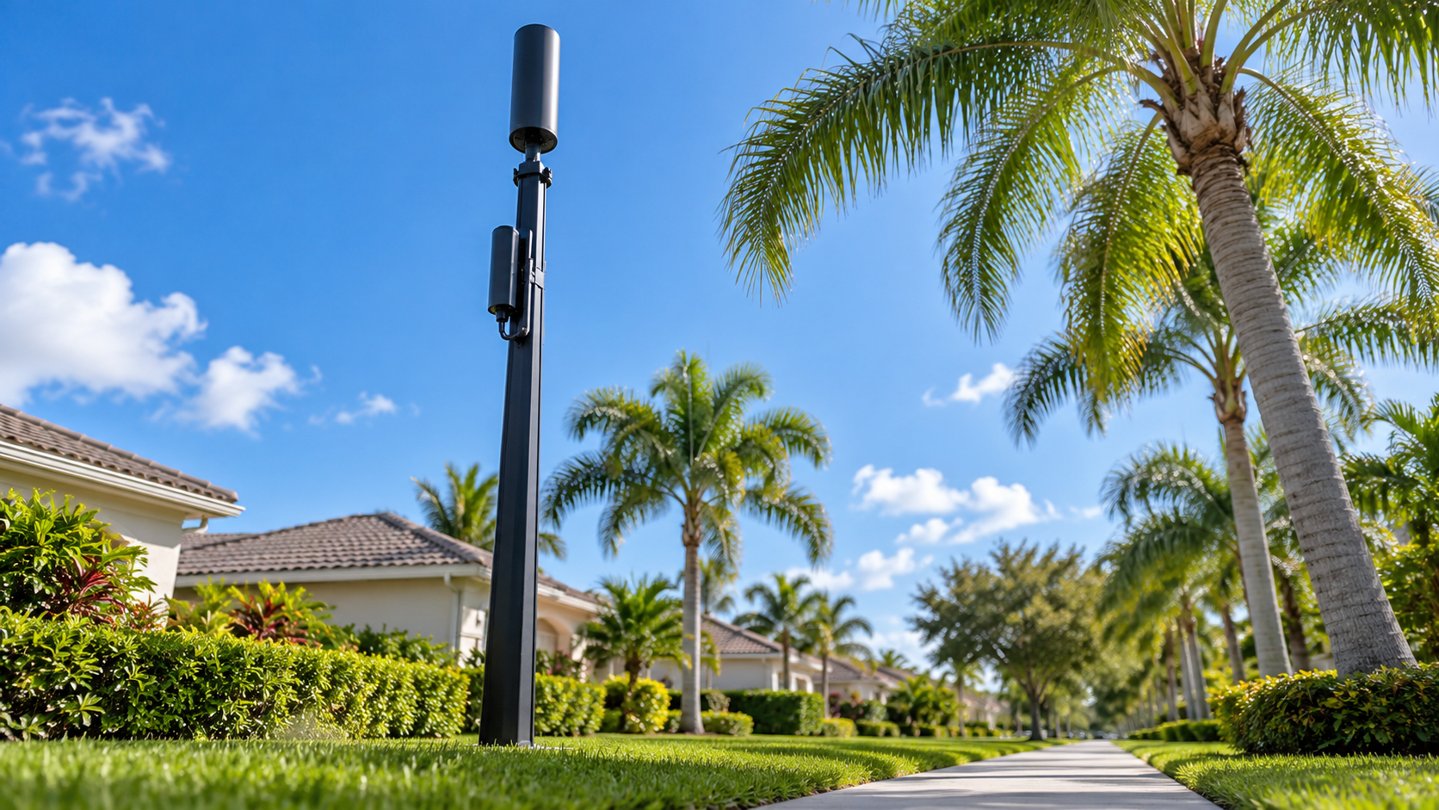
Some slim poles in neighborhood rights-of-way support small-cell wireless equipment, which adds cellular coverage or capacity. But a black pole is not automatically a 5G installation, a camera, or equipment belonging to a particular carrier.
The reliable way to identify one is to match the actual location and equipment to its owner or permit record. A general explanation of small cells cannot establish what a specific pole outside someone’s home does.
What a small cell does
Small cells are part of a wireless network. Carriers use them to strengthen service in places where existing coverage or capacity needs help. Equipment may be attached to an existing structure or supported by a dedicated pole.
Verizon, for example, describes small-cell deployment as a way to improve wireless coverage and data performance, particularly in areas where many devices compete for capacity. That describes the technology’s role, not the ownership or configuration of every installation in Sarasota or Manatee County.
The visible pole is only one clue. Equipment design varies, and appearance alone does not establish the network generation, frequency, service area, or whether additional devices are present.
Why poles appear in public rights-of-way
Florida section 337.401 establishes a framework for small wireless facilities and supporting poles in public rights-of-way. It limits some local regulatory powers while also addressing registration, permits, and installation requirements.
That framework is not the same as saying a carrier can put any object anywhere without review. Nor does a nearby homeowner’s preference, by itself, establish that an installation is unlawful. The useful question is which authority controls the location and what records apply to that installation.
A simple verification checklist
- Record the nearest address and intersection. Note which side of the road the pole occupies.
- Take a photograph from a public, safe location. Do not step into traffic or onto private property.
- Look for an asset or owner label that is readable without touching or opening anything.
- Check the relevant city or county permit-search system. Search the address and nearby right-of-way descriptions.
- If the record is unclear, ask permitting or right-of-way staff to identify the owner and the approved use.
The City of Sarasota provides a permit-search entrypoint. Outside city limits, use the responsible county or municipality instead. A Sarasota mailing address does not necessarily mean the City of Sarasota issued the permit.
Share what you can verify
If neighbors are asking about a new installation, a permit number and an official description are more useful than a confident guess. Share the source with the explanation, and distinguish a proposed permit from an installed, operating facility.
Do not open cabinets, climb a pole, remove labels, or interfere with equipment. Report a damaged installation or obstruction through official channels. Questions about a specific pole’s function, ownership, or compliance deserve specific records, not assumptions based on its color.
Primary sources: Florida small-wireless-facility law; Verizon’s small-cell explanation; City of Sarasota permit search.